
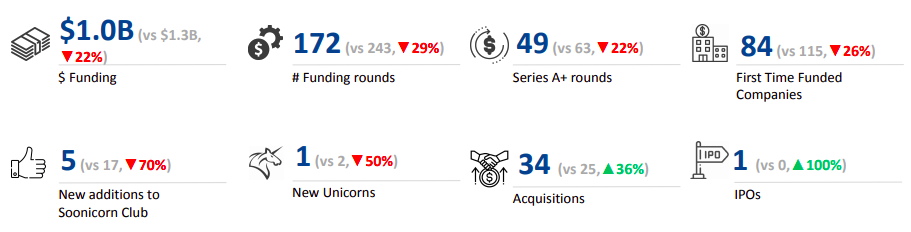
Tracxn, a leading global SaaS-based market intelligence platform, has released its Annual Report: Africa Tech Annual Report 2024. Based on Tracxn’s extensive database, the report provides insights into the African Tech space.
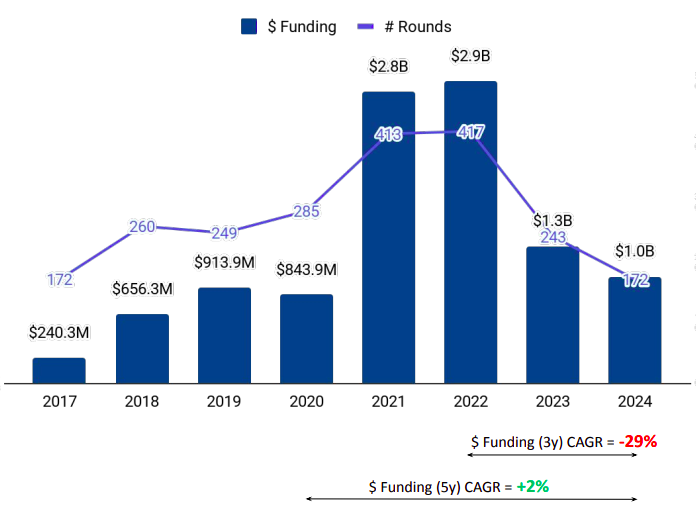
In 2024, African tech startups raised $1 billion in funding, representing a 22.36% decline from the $1.31 billion secured in 2023 and a sharp 64.7% drop compared to the $2.88 billion raised in 2022.
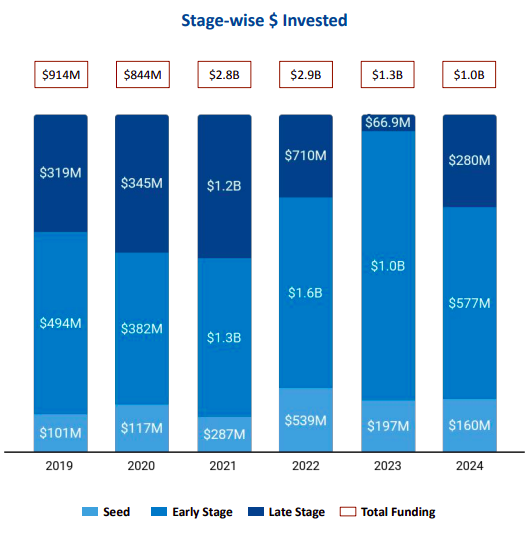
Stage-wise Investment Trends
● Late-Stage Funding: Late-stage investments surged to $0.28 billion in 2024, reflecting an impressive growth of nearly threefold from $0.07 billion in 2023.
● Seed-Stage Funding: Seed-stage investments dropped by 18.97%, falling to $0.16 billion in 2024 from $0.2 billion in 2023.
● Early-Stage Funding: Early-stage funding experienced a steep 44.83% decline, totaling $0.58 billion in 2024, down from $1.04 billion in 2023.
Sectoral Performance
Top-performing sectors in 2024 included FinTech, Enterprise Applications, and High Tech:
● FinTech: Funding decreased by 19.2% compared to 2023 and 52.0% compared to 2022.
● High Tech: Funding rose marginally by 3.13% compared to 2023 but declined significantly by 75.09% compared to 2022.
● Enterprise Applications: Funding increased by 14.7% in 2024 relative to 2023, though it dropped by 68.7% compared to 2022. \
Top cities leading the landscape
● Johannesburg-based tech firms accounted for 24.61% of all funding raised by African tech companies, leading the continent.
● Giza followed closely, contributing 18.11% of the total funding.
Leading Investors
Flat6Labs, Y Combinator, and 500 Global emerged as the top investors in the African tech ecosystem, actively supporting startups across various stages.
Mergers & Acquisitions
The African tech ecosystem recorded 34 acquisitions in 2024, up from 25 in 2023. Notable deals include:
● Adumo’s acquisition by Lesaka for $306M, the highest-valued deal of the year.
● Orcas’s acquisition by Baims for $11.0M.
This data underscores the evolving dynamics of the African tech ecosystem, reflecting both growth opportunities and challenges across different funding stages, sectors, and regions.